
Understanding the Meaning of Roman Numerals
Roman numerals are one of the oldest numbering systems still recognized today. They originated in ancient Rome and were widely used throughout the Roman Empire for trade, architecture, calendars, military records, and official documents. Even in modern times, Roman numerals continue to appear in books, movie titles, clocks, sporting events, outlines, and historical references. The sequence “xxv xxviii xxix xxvii xxiv xxv” represents a collection of Roman numeral values that showcase how numbers were written before the modern decimal system became dominant.
The topic of “xxv xxviii xxix xxvii xxiv xxv” Roman numerals is especially useful for students, researchers, and anyone interested in understanding classical numbering systems. Roman numerals may look complex at first glance, but once the symbols and their combinations are understood, reading them becomes straightforward and enjoyable.
Roman numerals use combinations of letters from the Latin alphabet. The primary symbols include I, V, X, L, C, D, and M. Each symbol carries a fixed value. For example, I equals 1, V equals 5, and X equals 10. By combining these symbols according to specific rules, larger numbers are formed. The sequence xxv, xxviii, xxix, xxvii, and xxiv demonstrates how numbers in the twenties are represented in Roman notation.
The Numerical Values of xxv xxviii xxix xxvii xxiv xxv
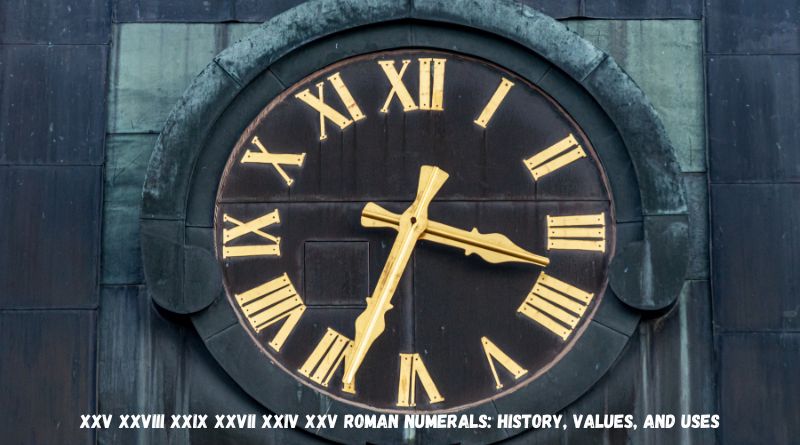
To fully understand this numbering sequence, it is important to break down each Roman numeral into its actual numerical value. These symbols follow simple addition and subtraction rules.
xxiv
The Roman numeral XXIV represents the number 24. Here, XX means 20 because X equals 10 and two X symbols together equal 20. IV equals 4 because I before V means one less than five. Therefore, XXIV equals 24.
xxv
XXV equals 25. The two X symbols represent 20, while V equals 5. Together they form 25.
xxvii
XXVII equals 27. XX represents 20, V equals 5, and II equals 2. Adding them together gives 27.
xxviii
XXVIII equals 28. XX means 20, V equals 5, and III equals 3. Together they total 28.
xxix
XXIX equals 29. XX equals 20, and IX equals 9 because I before X means one less than ten. Therefore, XXIX equals 29.
These examples show the logical structure behind Roman numerals. The sequence progresses naturally through the twenties while demonstrating both additive and subtractive numeral patterns.
The History Behind Roman Numerals
Roman numerals were developed in ancient Rome over two thousand years ago. Before modern Arabic numerals became common, Romans relied on letters to represent quantities. This system was practical for inscriptions, accounting, and public records.
The Roman Empire spread this numbering style across Europe, North Africa, and parts of Asia. Although Arabic numerals eventually replaced Roman numerals for most mathematical calculations, the historical importance of Roman notation has preserved its use in many modern contexts.
The sequence “xxv xxviii xxix xxvii xxiv xxv Roman Numerals” highlights the elegance of this ancient method. Roman numerals were designed for readability rather than advanced computation. Their visual appearance also made them ideal for monuments and official engravings.
Today, Roman numerals remain a symbol of tradition, sophistication, and historical continuity. Many schools still teach them as part of mathematics and history education.
Rules for Writing Roman Numerals
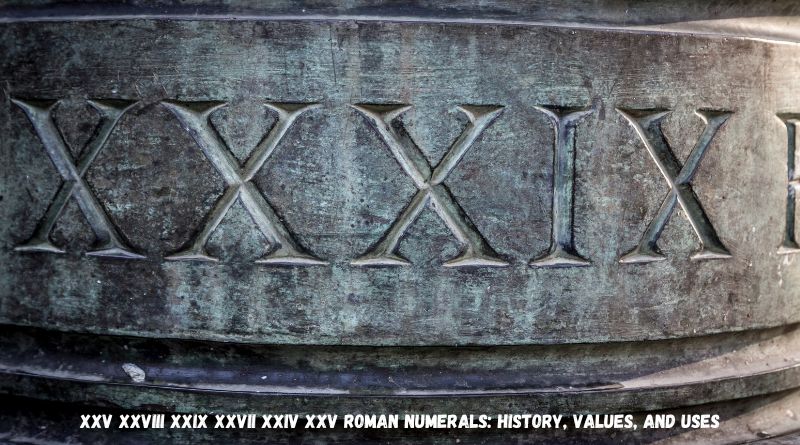
Roman numerals follow several key rules that help maintain consistency and clarity. Understanding these rules makes it easier to interpret sequences such as xxv xxviii xxix xxvii xxiv xxv.
Addition Rule
When a smaller or equal numeral follows a larger numeral, the values are added together. For example:
- XXV = 10 + 10 + 5 = 25
- XXVIII = 10 + 10 + 5 + 1 + 1 + 1 = 28
Subtraction Rule
When a smaller numeral appears before a larger numeral, subtraction occurs. Examples include:
- IV = 4
- IX = 9
This is why XXIV equals 24 and XXIX equals 29.
Repetition Rule
Certain numerals can be repeated up to three times in succession. For example:
- III = 3
- XXX = 30
However, symbols such as V, L, and D are generally not repeated.
Order Matters
Roman numerals are typically written from largest to smallest values moving from left to right. This order ensures readability and consistency across inscriptions and documents.
Modern Uses of Roman Numerals
Even though Arabic numerals dominate everyday mathematics, Roman numerals continue to appear in many areas of modern life. The phrase “xxv xxviii xxix xxvii xxiv xxv Roman Numerals” reflects a numbering tradition that still holds cultural and educational importance.
Clocks and Watches
Many traditional clocks display Roman numerals on their faces. This classic design gives timepieces a timeless and elegant appearance.
Book Chapters and Outlines
Authors frequently use Roman numerals to organize chapters, introductions, and appendices. This formatting style helps distinguish major sections from subsections.
Movie Sequels and Events
Roman numerals are commonly used in film titles and sporting events. Examples include championship games and movie series entries.
Historical Monuments
Buildings, monuments, and official documents often feature Roman numerals to indicate dates or ceremonial significance.
Educational Purposes
Schools teach Roman numerals to help students understand historical mathematics and number systems. Learning sequences such as xxiv, xxv, xxvii, xxviii, and xxix helps learners recognize numeral patterns effectively.
Why Roman Numerals Still Matter
Some people may wonder why Roman numerals are still taught when modern numbering systems are far more efficient. The answer lies in their historical, cultural, and intellectual value.
Roman numerals connect modern society to ancient civilization. They provide insight into how early societies organized trade, governance, and engineering projects. Understanding Roman numerals also improves pattern recognition and strengthens foundational mathematical reasoning.
The sequence “xxv xxviii xxix xxvii xxiv xxv” demonstrates how Roman numerals combine logic with symbolic representation. Even though they are not ideal for advanced calculations, they remain visually distinctive and culturally meaningful.
In literature, architecture, and design, Roman numerals symbolize prestige and permanence. Luxury brands, universities, and institutions often incorporate them into logos and official emblems because of their classical appeal.
Comparing Roman Numerals with Arabic Numerals
Roman numerals and Arabic numerals serve the same purpose of representing numbers, but they operate differently.
Arabic numerals use place value and zero, making arithmetic operations much easier. Roman numerals, by contrast, rely on combinations of letters and do not use positional notation.
For example:
- Arabic numeral 24 becomes XXIV in Roman notation
- Arabic numeral 29 becomes XXIX
While Roman numerals are visually elegant, calculations involving multiplication or division are far more difficult compared to modern numerical systems.
Despite this limitation, Roman numerals remain important for ceremonial, decorative, and educational purposes. Their continued use reflects the lasting influence of Roman civilization on modern culture.
Common Mistakes When Reading Roman Numerals
People unfamiliar with Roman numerals often make errors when interpreting sequences like xxv xxviii xxix xxvii xxiv xxv. Understanding common mistakes can improve accuracy.
Misreading Subtractive Pairs
One common mistake involves symbols such as IV or IX. These combinations use subtraction rather than addition.
- IV equals 4, not 6
- IX equals 9, not 11
Incorrect Symbol Order
Roman numerals follow specific ordering rules. Placing symbols incorrectly can change the intended value or create invalid combinations.
Excessive Repetition
Repeating symbols more than three times is generally incorrect. For instance, IIII is usually replaced with IV.
By practicing numeral conversion regularly, learners can quickly develop confidence in reading and writing Roman numbers.
Learning Roman Numerals Effectively
The best way to master Roman numerals is through repetition and practical examples. Beginners should first memorize the basic symbols and then practice converting small numbers.
Helpful learning strategies include:
- Writing daily dates in Roman numerals
- Practicing number conversion exercises
- Using Roman numeral clocks for recognition
- Reading historical texts and outlines
The sequence xxiv, xxv, xxvii, xxviii, and xxix is an excellent practice range because it includes both additive and subtractive patterns.
Students who consistently work with Roman numerals often find them easier to understand over time. The system may appear ancient, but its structure is highly logical once the rules are learned.
Conclusion
Roman numerals remain one of the most fascinating numbering systems in human history. The sequence “xxv xxviii xxix xxvii xxiv xxv Roman Numerals” highlights how ancient Romans represented numbers using combinations of alphabetic symbols. Each numeral follows clear mathematical rules based on addition and subtraction, making the system both practical and historically significant.
Although modern mathematics relies on Arabic numerals, Roman numerals continue to appear in education, architecture, entertainment, and design. Their enduring presence reflects the cultural legacy of ancient Rome and the timeless appeal of classical symbolism.
Understanding Roman numerals such as XXIV, XXV, XXVII, XXVIII, and XXIX helps learners appreciate the development of numerical systems throughout history. Whether used for education, decoration, or historical reference, Roman numerals continue to hold a unique place in modern society.
